
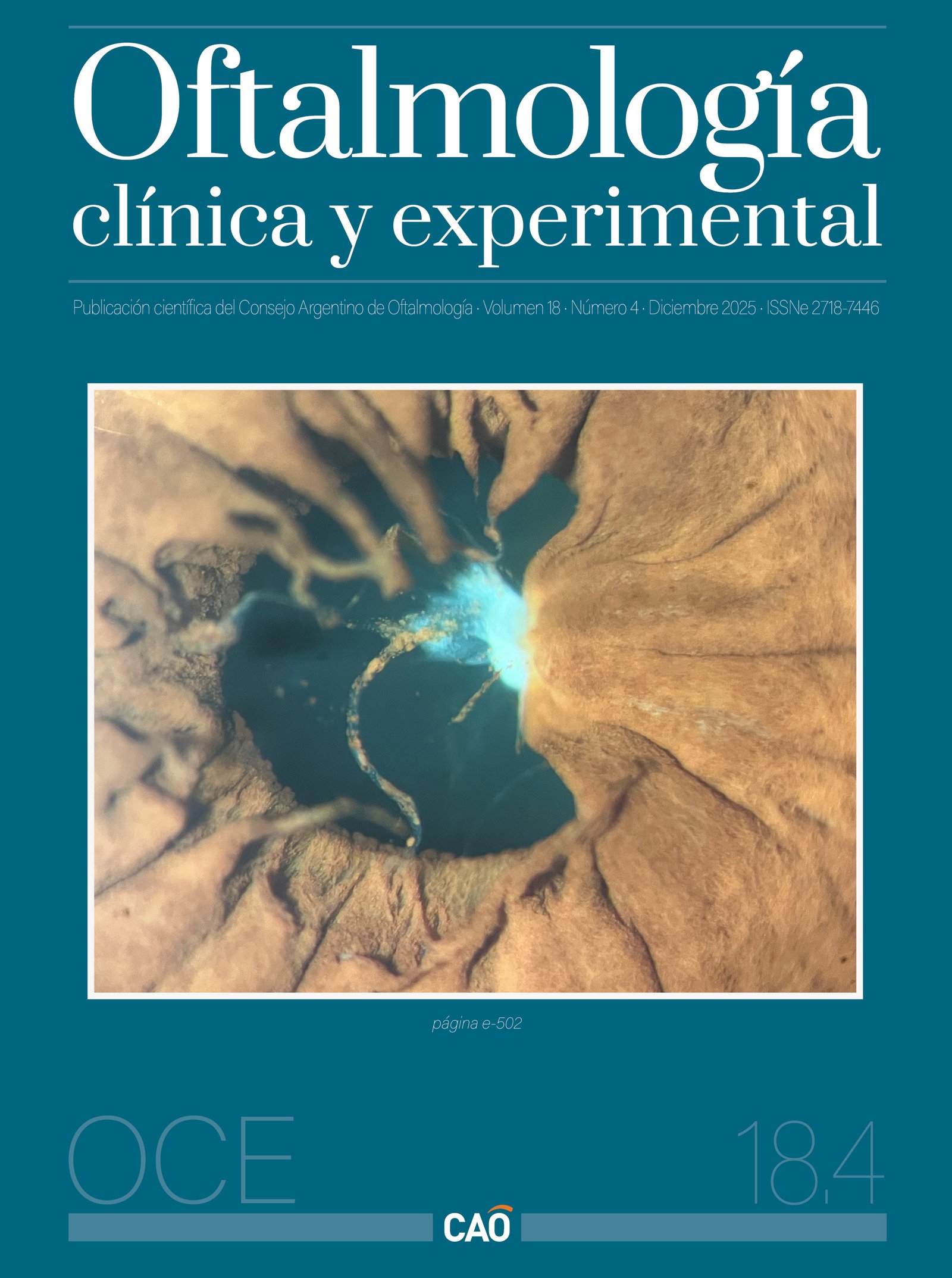
Persistent monocular iridocristalline pupillary membrane associated with anterior pyramidal cataract and severe ametropia
excimer laser refractive surgery (LASIK)
DOI:
https://doi.org/10.70313/2718.7446.v18.n4.458Keywords:
anterior pyramidal cataract, congenital anomalies of the iris, LASIK, myopia, persistent pupillary membrane, refractive surgeryAbstract
Objective: To describe a case of persistent pupillary membrane associated with anterior pyramidal cataract and severe ametropia, successfully treated with LASIK refractive surgery, and to analyze the available evidence on the relationship between the two conditions.
Case report: A 55-year-old woman, an emergency physician, with persistent pupillary membrane characterized on biomicroscopy by fine avascular and vascularized strands inserted into a lens with an anterior pyramidal cataract. She had significant myopia and astigmatism, with an initial best-corrected visual acuity of LogMAR 0.10. Preoperative studies were normal. LASIK refractive surgery with an excimer laser (WaveLight® EX500, Alcon) was indicated, with satisfactory results: uncorrected visual acuity of LogMAR 0.10 at one year follow-up, without complications and with full patient satisfaction.
Conclusion: Persistent iridocristalline pupillary membrane is a rare congenital anomaly that rarely contraindicates refractive surgery. There are no documented reports linking it to LASIK, nor is it considered a specific risk factor. In asymptomatic adults with significant ametropia, LASIK may be a valid alternative provided that the usual safety parameters are met.
Downloads
References
1. Sari A, Adigüzel U, Yeşilli M, Aydin O, Oz O. Persistent pupillary membranes in 3 siblings. J Cataract Refract Surg 2008; 34(3): 523-524. doi: 10.1016/j.jcrs.2007.09.043.
2. Alza AG. Case report: Congenital pseudoacorea in an ocular Axenfeld-Rieger syndrome: what is it? J Clin Cases Rep 2023; 6(4): 173-186. doi: 10.46619/joccr.2023.6-1145.
3. Alza AG, Galletto E. Pupiloplastia retroiridiana. Oftalmol Clín Exp 2022; 15(1): e40-e47.
4. Alza AG. Retroiridian pupilloplasty for phakic traumatic pseudoacorea: a novel minimally invasive surgical technique. J Clin Cases Rep 2025; 8(3): 103-110. doi: 10.46619/joccr.2025.8-1183
5. Schlaien S, Aguirre L, Perrone F, Zanutigh V. Membrana pupilar persistente versus membrana iridiana accesoria. Oftalmol Clín Exp 2023; 16(2): e215-e217.
6. Zerkaoui N, Laghmari A. Persistance de la membrane pupillaire bilatérale et forte myopie. Pan Afr Med J 2018; 29: 222. French. doi: 10.11604/pamj.2018.29.222.14297.
7. Matsuo T, Tanaka T. Managing persistent pupillary membranes with surgery or medication: a report of three cases. Cureus 2025; 17(6): e86695. doi: 10.7759/cureus.86695.
8. Laurencio LM, Arias L, Sánchez Olguín DF, Cinca L, Crespo B. (2014). Persistencia de membrana iridopupilar: manejo clínico y quirúrgico. Oftalmol Clín Exp 2014; 7(1): 31-34.
9. Chen Y, Zhu X, Zhang Q. [Nd: YAG laser therapy for persistent pupillary membranes]. Yan Ke Xue Bao 2002; 18(2):102-103.
10. Mansour AM, Hamade I, Antonios RS. Sequential argon-YAG laser membranotomy of extensive persistent pupillary membrane with visual loss. BMJ Case Rep 2015; 2015: bcr2015210140. doi: 10.1136/bcr-2015-210140.
Downloads
Published
Issue
Section
License
Copyright (c) 2025 Consejo Argentino de Oftalmología

This work is licensed under a Creative Commons Attribution-NonCommercial-NoDerivatives 4.0 International License.
Con esta licencia no se permite un uso comercial de la obra original, ni la generación de obras derivadas. Las licencias Creative Commons permiten a los autores compartir y liberar sus obras en forma legal y segura.
How to Cite