
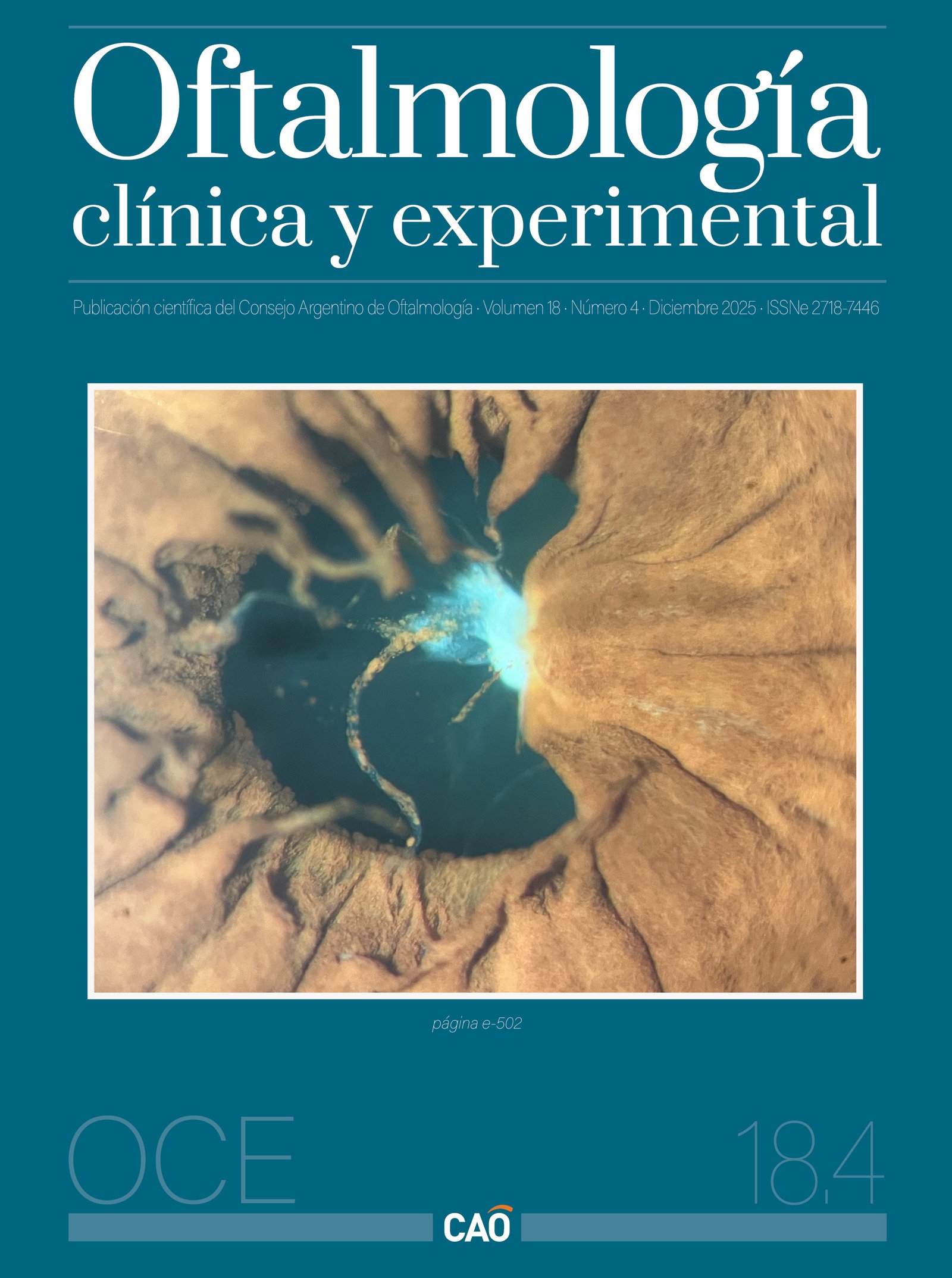
Unusual congenital cataract presenting as a Saturn ring structure
DOI:
https://doi.org/10.70313/2718.7446.v18.n4.461Keywords:
congenital cataract, annular opacities, toric intraocular lens, pediatric cataract surgeryAbstract
A case is presented of a 13-year-old female patient who attended consultation for decreased bilateral visual acuity, with an initial visual acuity of 1/10 in both eyes. Preoperative studies revealed high astigmatism associated with a congenital lens opacity showing an annular pattern resembling the rings of Saturn.
Bilateral cataract surgery was performed with implantation of monofocal toric intraocular lenses, achieving a postoperative uncorrected distance visual acuity of 10/10 in both eyes.
This image illustrates a rare and visually striking form of congenital cataract, in which the concentric arrangement of opacities offers both clinical and aesthetic interest. Its documentation contributes to understanding the morphological variability of congenital cataracts and highlights the importance of detailed preoperative assessment for personalized intraocular lens selection.
Downloads
References
1. Chan WH, Biswas S, Ashworth JL, Lloyd IC. Congenital and infantile cataract: aetiology and management. Eur J Pediatr 2012; 171(4): 625-630. doi: 10.1007/s00431-012-1700-1.
2. Santana A, Waiswo M. The genetic and molecular basis of congenital cataract. Arq Bras Oftalmol 2011; 74(2): 136-142. doi: 10.1590/s0004-27492011000200016.
3. Sheeladevi S, Lawrenson JG, Fielder AR, Suttle CM. Global prevalence of childhood cataract: a systematic review. Eye (Lond) 2016; 30(9): 1160-1169. doi: 10.1038/eye.2016.156.
4. Shiels A, Hejtmancik JF. Genetics of human cataract. Clin Genet 2013; 84(2): 120-127. doi: 10.1111/cge.12182.
5. Tan Y, Zou YS, Yu YL, Hu LY, Zhang T, Chen H, Jin L, Lin DR, Liu YZ, Lin HT, Liu ZZ. Classification of congenital cataracts based on multidimensional phenotypes and its association with visual outcomes. Int J Ophthalmol 2024; 17(3): 473-479. doi: 10.18240/ijo.2024.03.08.
Downloads
Published
Issue
Section
License
Copyright (c) 2025 Consejo Argentino de Oftalmología

This work is licensed under a Creative Commons Attribution-NonCommercial-NoDerivatives 4.0 International License.
Con esta licencia no se permite un uso comercial de la obra original, ni la generación de obras derivadas. Las licencias Creative Commons permiten a los autores compartir y liberar sus obras en forma legal y segura.
How to Cite